

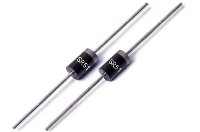

Hey there! As a supplier of UF4007, I often get asked about the maximum reverse current of this diode under normal operating conditions. So, I thought I'd write this blog to shed some light on the topic and help you understand what it means for your applications.
Let's start with the basics. The UF4007 is a high - efficiency fast - recovery rectifier diode. It's widely used in various electronic circuits, like power supplies, battery chargers, and voltage multipliers. You can check out more details about it on our UF4007 page.
Now, the reverse current of a diode is the current that flows through the diode when it's reverse - biased. In simple terms, when the voltage across the diode is in the opposite direction of its normal conduction direction, a small amount of current will still manage to pass through. This current is usually very small, but it's an important parameter to consider, especially in sensitive circuits.
Under normal operating conditions, the maximum reverse current of the UF4007 is typically specified by the manufacturer. Usually, at room temperature (around 25°C), the maximum reverse current (Ir) of the UF4007 is around 5 μA when the reverse voltage is at its rated maximum value. The rated reverse voltage of the UF4007 is 1000V. So, when you apply a reverse voltage of up to 1000V at 25°C, you can expect the reverse current to be no more than 5 μA.
But here's the thing, temperature has a big impact on the reverse current. As the temperature rises, the reverse current of the UF4007 increases significantly. This is because the thermal energy causes more electrons and holes to be generated in the semiconductor material of the diode, which in turn allows more current to flow in the reverse direction.
For example, at 100°C, the maximum reverse current can go up to around 50 μA. That's a ten - fold increase compared to the value at 25°C! So, if you're using the UF4007 in an environment where the temperature is likely to be high, you need to take this into account. It could affect the performance and reliability of your circuit.
Why does the reverse current matter? Well, in some applications, even a small reverse current can cause problems. In a high - impedance circuit, a relatively large reverse current can lead to power losses. These losses can cause the circuit to heat up, which might further increase the reverse current in a vicious cycle. In precision circuits, the reverse current can introduce errors in voltage measurements or other electrical parameters.
Now, let's compare the UF4007 with some other similar diodes. The HER208 and HER308 are also fast - recovery rectifier diodes. The HER208 has a lower rated current capacity compared to the UF4007, while the HER308 has a higher rated current capacity. In terms of reverse current, the values are also different. The HER208 and HER308 might have different maximum reverse current specifications depending on their design and intended applications.


When choosing between these diodes, you need to consider not only the reverse current but also other factors like forward voltage drop, recovery time, and power dissipation. The forward voltage drop is the voltage across the diode when it's conducting current in the forward direction. A lower forward voltage drop means less power loss in the diode during normal operation. The recovery time is how quickly the diode can switch from the conducting state to the non - conducting state. A shorter recovery time is better for high - frequency applications.
As a supplier of UF4007, I can tell you that we ensure the diodes we provide meet the specified maximum reverse current requirements. We test each batch of diodes to make sure they perform within the expected parameters. We also offer technical support to help you choose the right diode for your specific application.
If you're working on a project that requires a high - performance fast - recovery rectifier diode, the UF4007 could be a great choice. But you need to understand its characteristics, especially the maximum reverse current under different conditions. Whether you're building a small DIY project or a large - scale industrial circuit, getting the right diode is crucial for the success of your design.
If you're interested in purchasing UF4007 diodes, or if you have any questions about their performance, maximum reverse current, or how they fit into your circuit, don't hesitate to reach out. We're here to help you make the best decisions for your projects. Contact us to start a discussion about your requirements, and we'll work with you to find the perfect solution.
In conclusion, the maximum reverse current of the UF4007 under normal operating conditions (25°C and rated reverse voltage) is around 5 μA, but it increases with temperature. Understanding this parameter is essential for designing reliable and efficient electronic circuits. And if you're in the market for UF4007 diodes, we're your go - to supplier.
References
- Diode Datasheets (Manufacturer's specifications for UF4007, HER208, and HER308)
- Electronic Circuit Design Textbooks