


What is the reverse breakdown voltage of 1N4937?
As a reliable supplier of the 1N4937 fast - recovery diode, I'm often asked about the reverse breakdown voltage of this component. In this blog post, I'll delve into the concept of reverse breakdown voltage, specifically focusing on the 1N4937, and also compare it with some other related diodes in the market.
First, let's understand what reverse breakdown voltage means. In a diode, when a reverse bias is applied (that is, the anode is connected to the negative terminal and the cathode to the positive terminal of a power source), a small reverse leakage current flows through the diode. As the reverse - bias voltage increases, at a certain point, the diode will experience a sudden and large increase in reverse current. This voltage at which this sudden increase occurs is called the reverse breakdown voltage. Once the reverse breakdown voltage is reached, if the circuit does not have proper current - limiting measures, the diode may be damaged due to excessive power dissipation.
The 1N4937 is a fast - recovery diode known for its specific electrical characteristics. The reverse breakdown voltage of the 1N4937 is typically around 1000V. This relatively high reverse breakdown voltage makes it suitable for applications where high - voltage reverse bias may be encountered. For example, in power supply circuits, it can be used to protect against voltage spikes and reverse - voltage transients. When the power supply experiences a sudden change in voltage, the 1N4937 can withstand the reverse voltage up to its breakdown limit without being damaged, ensuring the stability and safety of the circuit.
To better understand the significance of the 1N4937's reverse breakdown voltage, let's compare it with other similar diodes in the market. Take the FR157 and FR307 for example. The FR157 has a reverse breakdown voltage of 1000V as well, which is the same as the 1N4937. This means that both diodes can handle similar high - voltage reverse - bias situations. However, other characteristics such as forward current rating and recovery time may differ between the two. The FR157 has a forward current rating of 1.5A, while the 1N4937 may have a different forward current capacity depending on its specific design and application requirements.
The FR307 also has a reverse breakdown voltage of 1000V. But it is designed to handle a higher forward current, up to 3A. This makes the FR307 more suitable for applications where larger forward currents are expected, such as in high - power rectifier circuits. On the other hand, the 1N4937 may be a better choice in applications where a balance between high - voltage protection and other electrical parameters is needed, especially when the forward current requirements are not as high as those of the FR307.
In practical applications, the reverse breakdown voltage of the 1N4937 plays a crucial role in circuit design. Engineers need to ensure that the maximum reverse voltage that the diode may encounter in the circuit is well below its breakdown voltage. This can be achieved through proper circuit layout, the use of voltage - limiting components, and accurate voltage calculations. For instance, in a switching power supply, the 1N4937 can be used in the output rectifier stage. By choosing a diode with a high enough reverse breakdown voltage, the power supply can operate stably even when there are small voltage fluctuations or transient spikes in the input or output voltage.
Another important aspect related to the reverse breakdown voltage is the temperature dependence. The reverse breakdown voltage of the 1N4937, like many other semiconductor devices, is affected by temperature. As the temperature increases, the reverse breakdown voltage may decrease slightly. This means that in high - temperature environments, engineers need to take this into account when designing circuits. They may need to derate the diode's reverse breakdown voltage to ensure reliable operation. For example, if the circuit is expected to operate in an environment with a high ambient temperature, the maximum reverse voltage applied to the 1N4937 should be set lower than its rated breakdown voltage at room temperature.
When it comes to the manufacturing process of the 1N4937, strict quality control measures are taken to ensure the consistency of the reverse breakdown voltage. Each batch of diodes is tested to meet the specified electrical parameters, including the reverse breakdown voltage. The manufacturing process involves precise doping and semiconductor fabrication techniques to achieve the desired electrical characteristics. Any deviation in the manufacturing process can affect the reverse breakdown voltage and other parameters of the diode. Therefore, as a supplier, we work closely with our manufacturing partners to ensure that every 1N4937 diode we provide meets the high - quality standards.
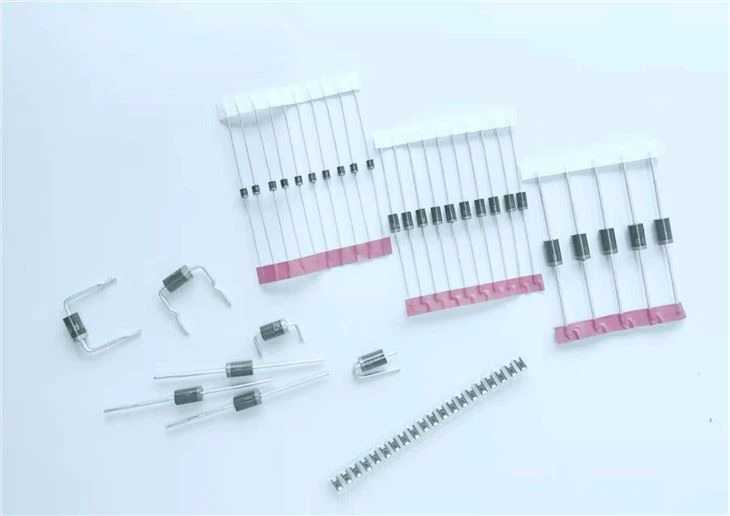

In addition to its high reverse breakdown voltage, the 1N4937 also has a relatively fast recovery time. The fast recovery time means that the diode can quickly switch from the conducting state to the non - conducting state when the voltage polarity changes. This is especially important in high - frequency applications, such as in high - speed switching circuits. A fast - recovery diode like the 1N4937 can reduce power losses and improve the efficiency of the circuit.
If you are involved in circuit design and are looking for a reliable fast - recovery diode with a high reverse breakdown voltage, the 1N4937 could be an excellent choice. Our company has been in the business of supplying high - quality electronic components for many years, and we can provide you with the 1N4937 diodes that meet your specific requirements. Whether you need a small quantity for prototyping or a large volume for mass production, we can offer you competitive prices and excellent service.
We understand that different applications may have different requirements for the 1N4937. Our technical support team is always ready to assist you in choosing the right diode for your project. We can provide detailed technical specifications, application notes, and even help you with circuit design if needed. If you have any questions about the reverse breakdown voltage, forward current rating, or any other aspect of the 1N4937, please don't hesitate to contact us. We are eager to engage in procurement discussions with you to find the best solution for your electronic component needs.
In conclusion, the reverse breakdown voltage of the 1N4937 is an important parameter that determines its suitability for various high - voltage applications. With its high breakdown voltage, fast recovery time, and reliable performance, it is a popular choice among engineers and circuit designers. If you are interested in learning more about the 1N4937 or other fast - recovery diodes, feel free to visit our website 1N4937 or contact us for more information. We look forward to working with you on your next project.
References
- Semiconductor Device Physics and Design textbooks
- Manufacturer's datasheets for 1N4937, FR157, and FR307 diodes