

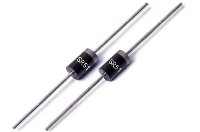

Hey there! As a supplier of 1N5819 diodes, I often get asked about the junction temperature rise of these little components under normal operation. It's a super important topic, especially for anyone who's using these diodes in their projects or products. So, let's dive right in and explore what's going on with that junction temperature.
First off, what's the 1N5819 all about? Well, it's a Schottky diode, which means it has some pretty unique characteristics compared to regular diodes. Schottky diodes have a low forward voltage drop, which makes them great for applications where power efficiency is key. You can check out more details about the 1N5819 on our website.
Now, let's talk about junction temperature. The junction is where the P-type and N-type semiconductor materials meet inside the diode. When current flows through the diode, it generates heat at this junction. The amount of heat generated depends on a few factors, like the forward current flowing through the diode and the forward voltage drop across it.
Under normal operation, the 1N5819 is designed to handle a certain amount of current. The datasheet usually specifies the maximum forward current, which for the 1N5819 is typically around 1A. When the diode is operating at or near this maximum current, the junction temperature will start to rise.
The rate at which the junction temperature rises depends on the thermal resistance of the diode. Thermal resistance is a measure of how well the diode can transfer heat from the junction to the outside environment. A lower thermal resistance means the diode can dissipate heat more effectively, which helps keep the junction temperature down.
So, how do we calculate the junction temperature rise? Well, it's not too complicated. We can use the following formula:
ΔTj = P * Rθja
Where:
- ΔTj is the junction temperature rise (in °C)
- P is the power dissipated by the diode (in watts)
- Rθja is the thermal resistance from the junction to the ambient environment (in °C/W)
The power dissipated by the diode can be calculated using the formula:
P = If * Vf
Where:
- If is the forward current flowing through the diode (in amps)
- Vf is the forward voltage drop across the diode (in volts)
Let's say we have a 1N5819 diode with a forward current of 1A and a forward voltage drop of 0.4V. The power dissipated by the diode would be:
P = 1A * 0.4V = 0.4W
Now, let's assume the thermal resistance from the junction to the ambient environment is 60°C/W. Using the formula for junction temperature rise, we can calculate:
ΔTj = 0.4W * 60°C/W = 24°C
This means that if the ambient temperature is 25°C, the junction temperature of the diode would be 25°C + 24°C = 49°C.
It's important to note that these calculations are based on ideal conditions. In real-world applications, there are other factors that can affect the junction temperature, such as the layout of the circuit board, the presence of heat sinks, and the airflow around the diode.
If the junction temperature gets too high, it can have a negative impact on the performance and reliability of the diode. High temperatures can cause the diode to degrade over time, leading to increased forward voltage drop, reduced reverse breakdown voltage, and even failure.
To prevent the junction temperature from getting too high, it's important to design the circuit with proper thermal management in mind. This might include using heat sinks, fans, or other cooling methods to help dissipate the heat generated by the diode.
Now, let's compare the 1N5819 with some other Schottky diodes, like the SR860 and the SR240. These diodes have different specifications and are designed for different applications.
The SR860 is a high-current Schottky diode that can handle up to 8A of forward current. It has a lower forward voltage drop than the 1N5819, which means it can dissipate less power and generate less heat. However, it also has a higher thermal resistance, which means it might require more effective cooling methods to keep the junction temperature down.
The SR240 is a lower-current Schottky diode that can handle up to 2A of forward current. It has a similar forward voltage drop to the 1N5819, but it has a lower thermal resistance, which means it can dissipate heat more effectively.
So, when choosing a Schottky diode for your application, it's important to consider the specific requirements of your circuit, such as the current and voltage levels, the operating temperature range, and the available cooling methods.
In conclusion, the junction temperature rise of a 1N5819 under normal operation depends on a variety of factors, including the forward current, the forward voltage drop, and the thermal resistance of the diode. By understanding these factors and taking proper thermal management measures, you can ensure that your 1N5819 diodes operate reliably and efficiently.
If you're interested in purchasing 1N5819 diodes or have any questions about their performance or application, feel free to reach out to us. We're here to help you find the right solution for your needs.


References:
- Datasheets of 1N5819, SR860, and SR240
- General knowledge of semiconductor physics and thermal management