

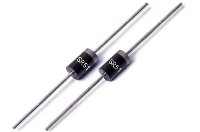

As a supplier of UF4007 diodes, I've witnessed firsthand the importance of understanding how different electrical parameters affect the performance of these components. One crucial aspect that often comes up in technical discussions is the relationship between reverse bias voltage and junction capacitance in UF4007 diodes. In this blog post, I'll delve into this topic, exploring the science behind it and its practical implications for users of UF4007 and similar diodes.
Understanding the Basics: What is a Diode and Junction Capacitance?
Before we dive into the effects of reverse bias voltage on junction capacitance, let's briefly review what a diode is and what junction capacitance means. A diode is a two-terminal electronic component that allows current to flow in one direction while blocking it in the opposite direction. It consists of a p-n junction, which is formed by joining a p-type semiconductor (with an excess of holes) and an n-type semiconductor (with an excess of electrons).
Junction capacitance, on the other hand, is a property of the p-n junction in a diode. It arises due to the presence of a depletion region at the junction, which acts as a dielectric between two conductive regions (the p-type and n-type semiconductors). When a voltage is applied across the diode, charge carriers accumulate on either side of the depletion region, creating an electric field and a capacitance.
The Role of Reverse Bias Voltage
When a diode is reverse-biased, the external voltage is applied in such a way that it opposes the flow of current through the diode. In this state, the depletion region widens as the majority carriers are pulled away from the junction. As the depletion region widens, the distance between the charge carriers on either side of the junction increases, which in turn affects the junction capacitance.

The relationship between reverse bias voltage and junction capacitance can be described by the following equation:
[ C_j = \frac{C_{j0}}{\sqrt{1 + \frac{V_R}{\phi_0}}} ]
Where:
- ( C_j ) is the junction capacitance at a given reverse bias voltage ( V_R )
- ( C_{j0} ) is the zero-bias junction capacitance
- ( \phi_0 ) is the built-in potential of the p-n junction
From this equation, we can see that as the reverse bias voltage ( V_R ) increases, the denominator of the fraction increases, causing the junction capacitance ( C_j ) to decrease. This inverse relationship between reverse bias voltage and junction capacitance is a fundamental characteristic of p-n junctions and has important implications for the performance of diodes in various applications.

Practical Implications for UF4007 Diodes
In the case of UF4007 diodes, the junction capacitance plays a crucial role in determining their high-frequency performance. A lower junction capacitance means that the diode can switch more quickly between the on and off states, making it suitable for applications that require high-speed operation, such as rectification in switching power supplies and high-frequency signal processing.
For example, in a switching power supply, the UF4007 diode is used to convert the high-frequency alternating current (AC) output of the transformer into direct current (DC). A lower junction capacitance allows the diode to turn off more rapidly, reducing the power loss due to reverse recovery time and improving the overall efficiency of the power supply.
On the other hand, in applications where high capacitance is required, such as in coupling and bypass circuits, a different diode with a higher junction capacitance may be more suitable. For instance, HER308 and HER208 diodes may be better choices in some cases, as they have different electrical characteristics compared to the UF4007.
Measuring Junction Capacitance in UF4007 Diodes
To accurately measure the junction capacitance of UF4007 diodes at different reverse bias voltages, specialized test equipment is required. One common method is to use a capacitance meter that can apply a known reverse bias voltage to the diode and measure the resulting capacitance.
In a laboratory setting, a network analyzer can also be used to measure the scattering parameters (S-parameters) of the diode, from which the junction capacitance can be calculated. These measurements are typically performed over a range of frequencies and reverse bias voltages to fully characterize the diode's performance.
Factors Affecting the Reverse Bias - Junction Capacitance Relationship
While the equation for junction capacitance provides a theoretical framework for understanding the relationship between reverse bias voltage and capacitance, several factors can affect this relationship in real-world applications.
- Temperature: The junction capacitance of a diode is temperature-dependent. As the temperature increases, the mobility of charge carriers in the semiconductor material changes, which can affect the width of the depletion region and the junction capacitance. In general, the junction capacitance decreases with increasing temperature.
- Semiconductor Material and Doping Concentration: The type of semiconductor material used in the diode and its doping concentration can also affect the junction capacitance. Different materials have different dielectric constants, and the doping concentration determines the width of the depletion region at zero bias.
- Manufacturing Variations: Even within a batch of UF4007 diodes, there can be small variations in the junction capacitance due to manufacturing processes. These variations can be minimized through quality control measures, but they still need to be considered when designing circuits that rely on precise capacitance values.
Applications and Considerations
The understanding of how reverse bias voltage affects the junction capacitance of UF4007 diodes is crucial for engineers and designers when selecting diodes for specific applications.
- High - Frequency Applications: In high - frequency circuits, such as radio frequency (RF) receivers and transmitters, minimizing the junction capacitance is essential to reduce signal distortion and improve the overall performance of the circuit. UF4007 diodes can be a good choice for these applications due to their relatively low junction capacitance at high reverse bias voltages.
- Power Electronics: In power electronics applications, such as DC - DC converters and motor drives, the reverse recovery characteristics of the diode, which are related to the junction capacitance, can significantly impact the efficiency and reliability of the system. Designers need to carefully select diodes with appropriate junction capacitance values to optimize the performance of these systems.
Conclusion
In conclusion, the reverse bias voltage has a significant impact on the junction capacitance of UF4007 diodes. As the reverse bias voltage increases, the junction capacitance decreases, which can be beneficial for high - speed and high - frequency applications. However, other factors such as temperature, semiconductor material, and manufacturing variations also need to be considered when designing circuits using these diodes.
If you're in the market for high - quality UF4007 diodes or need more information about their electrical characteristics, we're here to help. Our team of experts can provide you with detailed technical support and assist you in selecting the right diodes for your specific applications. Contact us to start a procurement discussion and take your projects to the next level.

References
- Streetman, B. G., & Banerjee, S. K. (2006). Solid State Electronic Devices. Prentice Hall.
- Neamen, D. A. (2012). Semiconductor Physics and Devices: Basic Principles. McGraw - Hill.
- Millman, J., & Grabel, A. (1987). Microelectronics. McGraw - Hill.