


Can FR207 be used in radio frequency circuits? That's a question I've been asked a bunch of times as a supplier of FR207 diodes. Let's dig into this topic and see if this little component can handle the high - speed demands of radio frequency (RF) circuits.
First off, let's talk about what FR207 is. The FR207 is a fast - recovery diode. It's designed to switch from the conducting state to the non - conducting state quickly. This characteristic makes it a popular choice in many power supply and rectifier circuits. It has a repetitive peak reverse voltage of 1000V and an average forward current of 2A, which means it can handle a decent amount of power in DC applications.
Now, when it comes to RF circuits, things get a bit more complicated. RF circuits operate at high frequencies, typically from a few kilohertz to several gigahertz. In these circuits, components need to have low parasitic capacitance, low inductance, and fast switching speeds to minimize signal loss and distortion.

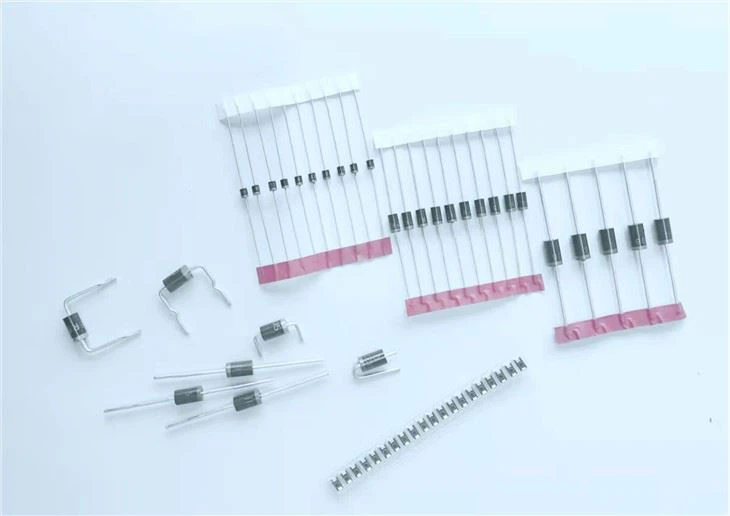
One of the key issues with using FR207 in RF circuits is its parasitic capacitance. The FR207 has a relatively high junction capacitance. At high frequencies, this capacitance can act as a short - circuit, allowing the RF signal to bypass the intended path. This results in a loss of signal strength and can cause interference in the circuit.
Another factor is the switching speed. While the FR207 is a fast - recovery diode, it might not be fast enough for some high - frequency RF applications. In RF circuits, the signals change direction extremely rapidly, and the diode needs to be able to keep up. If the switching speed is too slow, the diode won't be able to turn on and off in time, leading to signal distortion.
However, it's not all bad news. There are some low - frequency RF applications where the FR207 might work. For example, in AM radio circuits operating in the kilohertz range, the requirements for component speed and parasitic capacitance are not as strict. In these cases, the FR207 can be used as a rectifier to convert the RF signal into a DC signal.
If you're looking for alternatives for high - frequency RF circuits, there are other diodes that are better suited. For instance, the SF24 Super Fast Recovery Diode has a much lower junction capacitance and a faster switching speed compared to the FR207. It's designed specifically for high - speed switching applications, making it a great choice for RF circuits. Another option is the FR157, which also has good recovery characteristics and can handle moderate - frequency RF signals. And the SF34 is another super - fast recovery diode that can be used in RF circuits where high power and fast switching are required.
As a supplier of FR207 diodes, I understand that every project has its own unique requirements. If you're working on a low - frequency RF project and think the FR207 might be a good fit, I'd be more than happy to provide you with samples to test. And if you need a diode for high - frequency applications, I can also offer you some of the alternatives I mentioned above.
If you're interested in purchasing FR207 diodes or any of the other diodes I've discussed, feel free to reach out. We can have a chat about your specific needs and see how we can help you get the right components for your project. Whether it's for a small hobby project or a large - scale industrial application, we've got you covered.
In conclusion, while the FR207 has its limitations in high - frequency RF circuits, it can still be useful in some low - frequency applications. But for more demanding RF projects, it's advisable to look at other options. Don't hesitate to contact me if you have any questions or need further advice on choosing the right diode for your circuit.
References:
- Electronic Components Handbook
- RF Circuit Design Principles