

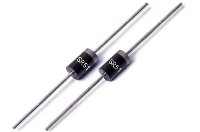

Hey there! As a supplier of MB6S, I often get asked about the voltage rating of MB6S under different humidity conditions. So, I thought I'd write this blog to share some insights on this topic.
First off, let's quickly understand what MB6S is. MB6S is a popular bridge rectifier. You can find more detailed info about it on this page: MB6S. Bridge rectifiers are crucial components in power supply circuits, converting alternating current (AC) to direct current (DC).
Now, humidity can have an impact on electronic components, and MB6S is no exception. Under normal humidity conditions, say around 40 - 60% relative humidity (RH), the MB6S usually performs as specified in its datasheet. The typical voltage rating of MB6S is around 600V. This means it can handle AC input voltages up to a certain level and convert them to DC effectively.
But when the humidity starts to change, things can get a bit different. In low - humidity environments, like below 20% RH, the air is very dry. This can sometimes lead to static electricity build - up. Static electricity can cause damage to the internal structure of the MB6S. Although the voltage rating itself might not change immediately, the risk of component failure due to electrostatic discharge (ESD) increases. So, in these conditions, extra precautions need to be taken, such as using anti - static packaging and grounding the work area.
On the other hand, high - humidity conditions, above 80% RH, pose a different set of challenges. Moisture in the air can condense on the surface of the MB6S. This can lead to a decrease in the insulation resistance between different parts of the component. As a result, there might be a slight reduction in the effective voltage rating. The moisture can also cause corrosion over time, which can further degrade the performance of the MB6S.
Let's take a look at some real - world scenarios. In a tropical region where the humidity is often high, say around 85 - 90% RH, if the MB6S is used in an outdoor power supply unit, the constant exposure to high humidity can gradually reduce its ability to handle high voltages. The voltage rating might drop by a few percentage points, maybe around 5 - 10% over time. This means that if you were relying on the full 600V rating in normal conditions, you might need to derate it a bit in such high - humidity environments.
Now, it's important to compare MB6S with other similar bridge rectifiers. For example, ABS10 and DB107S. The ABS10 has a different voltage rating and might have a different response to humidity. It generally has a higher voltage rating compared to MB6S, around 1000V. In high - humidity conditions, it might be more resilient due to its better insulation design. The DB107S, on the other hand, has a voltage rating of around 1000V as well, but its internal structure is different. It might be more sensitive to humidity in terms of surface moisture absorption.


To measure the voltage rating of MB6S under different humidity conditions, we can use specialized test equipment. A humidity chamber can be used to control the humidity level accurately. We can then apply different AC voltages to the MB6S and measure the output DC voltage. By monitoring the performance of the MB6S at different humidity levels, we can determine how the voltage rating changes.
As a supplier, I've seen many customers facing issues related to humidity and component performance. That's why we always recommend proper storage and usage conditions. If you're using MB6S in an environment with extreme humidity, it's a good idea to use protective enclosures or coatings. These can help prevent moisture from reaching the component and maintain its voltage rating.
If you're in the market for high - quality MB6S or other bridge rectifiers like ABS10 and DB107S, we're here to help. Whether you need them for small - scale projects or large - scale industrial applications, we can provide you with the right products. We've got a wide range of inventory and can ensure timely delivery.
If you have any questions about the voltage rating of MB6S under different humidity conditions or want to discuss your specific requirements, feel free to reach out. We're more than happy to have a chat and help you make the best choice for your project.
In conclusion, the voltage rating of MB6S can be affected by humidity. Low humidity brings the risk of ESD, while high humidity can cause insulation degradation and corrosion. By understanding these factors and taking appropriate measures, you can ensure the reliable performance of MB6S in your circuits.
References
- "Handbook of Electronic Component Reliability"
- Datasheets of MB6S, ABS10, and DB107S