

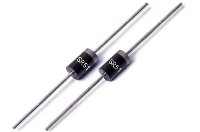

Yo, what's up everyone! I'm a supplier of DB107S, and today I wanna talk about the noise performance of a circuit with DB107S.
First off, let's understand what we mean by noise in a circuit. Noise in an electrical circuit is basically any unwanted electrical signal that interferes with the desired signal. It can come from a bunch of different sources, like thermal noise, shot noise, and flicker noise. And when it comes to a circuit with DB107S, understanding its noise performance is crucial for getting the best out of your electronic devices.
DB107S is a popular bridge rectifier. Bridge rectifiers are used to convert alternating current (AC) to direct current (DC). They're a key component in a lot of power supply circuits. Now, when we're talking about the noise performance of a circuit with DB107S, we need to look at a few factors.
One of the main things that affects the noise in a circuit with DB107S is the switching process. When the DB107S is switching between conducting and non - conducting states, there can be sudden changes in current and voltage. These sudden changes can generate electrical noise. For example, during the turn - on and turn - off times of the rectifier, there are rapid transitions in the current flow. This can cause high - frequency noise spikes, which can then spread throughout the circuit.
Another factor is the parasitic elements in the circuit. Parasitic elements are unwanted electrical components that exist due to the physical properties of the circuit layout. In a circuit with DB107S, there can be parasitic capacitances and inductances. These parasitic elements can resonate with the switching frequency of the rectifier, leading to an increase in noise levels. For instance, a parasitic inductance in the leads of the DB107S can cause voltage spikes when the current changes rapidly.
The operating environment also plays a role. If the circuit is operating in a high - temperature environment, the thermal noise in the DB107S and other components can increase. Thermal noise is caused by the random motion of electrons due to heat. As the temperature goes up, the electrons move more randomly, and this results in more noise.
Now, let's compare the noise performance of DB107S with some other bridge rectifiers. There are a few popular ones out there, like MB6S and ABS10.
The MB6S is a smaller bridge rectifier compared to DB107S. It's often used in low - power applications. In terms of noise, the MB6S generally has lower noise levels in low - power circuits because it has less current flowing through it. Since there are fewer electrons moving around, there's less chance of generating noise. However, in high - power applications, the DB107S is more suitable, but it might generate more noise due to the higher current levels.
The ABS10 is also a well - known bridge rectifier. It has a different design and construction compared to DB107S. The ABS10 might have a different noise profile, depending on the application. In some cases, it might have better noise performance in circuits where the switching frequency is relatively low. But in high - frequency switching circuits, the DB107S might be a better choice, even though it requires more attention to noise management.
So, how can we improve the noise performance of a circuit with DB107S? There are a few things we can do.
First, we can use proper filtering. Adding capacitors and inductors in the circuit can help filter out the high - frequency noise. For example, a capacitor across the output of the DB107S can smooth out the DC voltage and reduce the ripple, which is a form of noise. Inductors can be used in series with the circuit to block high - frequency noise from passing through.


Second, we need to pay attention to the circuit layout. A good layout can minimize the parasitic elements. For example, keeping the leads of the DB107S short can reduce the parasitic inductance. Also, separating the high - current and low - current parts of the circuit can prevent the noise from spreading.
Finally, using shielding can be very effective. Shielding the DB107S and other sensitive components can block external electromagnetic interference, which can also contribute to the overall noise in the circuit.
As a supplier of DB107S, I know how important it is to get the best noise performance out of this component. Whether you're working on a small - scale project or a large - scale industrial application, the noise in your circuit can have a big impact on the performance of your device.
If you're looking to source high - quality DB107S for your projects, I'm here to help. I can provide you with all the technical support you need to ensure that you're using the DB107S in the most efficient way possible, especially when it comes to managing the noise in your circuit. So, if you're interested in purchasing DB107S or have any questions about its noise performance, feel free to reach out and start a procurement discussion.
References
- Electronics textbooks on bridge rectifiers and circuit noise analysis
- Manufacturer's datasheets for DB107S, MB6S, and ABS10