

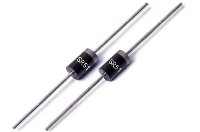

Hey there! As a supplier of 1N4937 diodes, I often get asked about the forward voltage of these little components. So, let's dive right in and explore what the forward voltage of 1N4937 is all about.
First off, what exactly is forward voltage? Well, in simple terms, it's the voltage drop across a diode when it's forward - biased. That means when the diode is allowing current to flow through it in the direction it's designed to. For a diode like the 1N4937, understanding the forward voltage is crucial for proper circuit design and performance.
The forward voltage of a 1N4937 isn't a fixed value. It can vary depending on a few factors. One of the main factors is the current flowing through the diode. Generally, as the current increases, the forward voltage also increases. This relationship is described by the diode's forward - current characteristic curve.
Let's take a closer look at some typical values. Under normal operating conditions, the forward voltage of a 1N4937 is usually around 1.2V when the forward current is 1A. But this can change. If the current is lower, say 0.1A, the forward voltage might drop to around 0.9V. And if you push the current up to 2A, the forward voltage could rise to about 1.4V.
Why does this matter? Well, in a circuit, if you're not accounting for the forward voltage of the 1N4937, you might run into problems. For example, if you're using the diode in a power - supply circuit, the forward voltage drop can affect the output voltage. If you're not aware of it, your circuit might not work as expected.
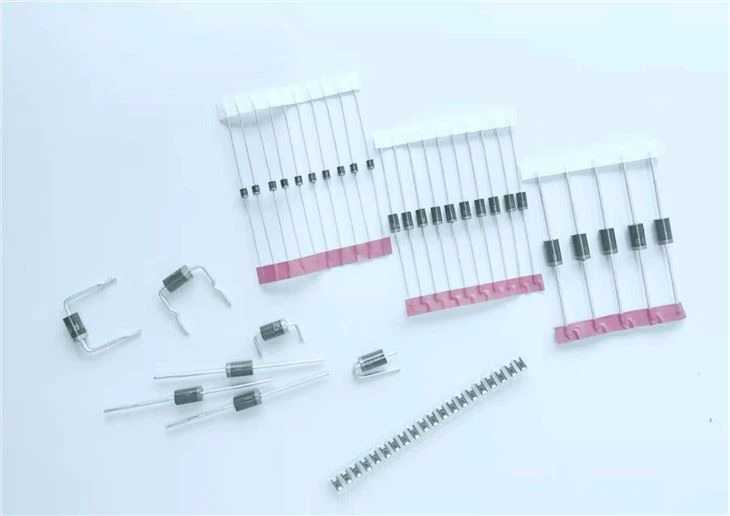

Now, let's compare the 1N4937 with some other similar diodes. For instance, the FR207 and FR157. These are also fast - recovery diodes, but their forward voltage characteristics can be different. The FR207, for example, has a forward voltage of around 1.1V at 1A. The 1N4937 might have a slightly higher forward voltage in some cases, which could be a consideration depending on your circuit requirements.
Another factor that can influence the forward voltage of the 1N4937 is temperature. As the temperature goes up, the forward voltage of the diode tends to decrease. This is due to the physical properties of the semiconductor material inside the diode. So, if you're operating your circuit in a high - temperature environment, you need to take this into account.
Let's talk a bit about how the forward voltage affects the efficiency of a circuit. When a diode has a higher forward voltage, more power is dissipated as heat. This means that less of the input power is actually being used for the intended purpose of the circuit. So, if you're designing a circuit where efficiency is key, you might want to look for a diode with a lower forward voltage.
In some applications, like high - frequency circuits, the forward voltage of the 1N4937 can also impact the performance. A higher forward voltage can cause more signal distortion and reduce the overall efficiency of the circuit. So, it's important to choose the right diode for the job.
Now, I know some of you might be thinking, "Okay, this is all great information, but how do I actually use this in my projects?" Well, when you're designing a circuit with a 1N4937, you need to calculate the power dissipation based on the forward voltage and the current. You can use the formula P = Vf * If, where P is the power dissipation, Vf is the forward voltage, and If is the forward current.
Let's say you have a circuit where the forward current is 0.5A and the forward voltage of the 1N4937 is 1.1V. Using the formula, the power dissipation would be P = 1.1V * 0.5A = 0.55W. This is important because if the power dissipation is too high, the diode could overheat and fail.
As a supplier of 1N4937 diodes, I can tell you that we test our products to ensure that they meet the specified forward voltage requirements. We use advanced testing equipment to measure the forward voltage at different currents and temperatures. This way, you can be confident that the diodes you're getting from us will perform as expected in your circuits.
If you're in the market for 1N4937 diodes or any other related components, we're here to help. We have a wide range of high - quality diodes that can meet your needs. Whether you're a hobbyist working on a small project or an engineer designing a large - scale circuit, we've got you covered.
If you have any questions about the forward voltage of 1N4937 or any other technical details, feel free to reach out. We're always happy to have a chat and help you find the right components for your project. And if you're ready to make a purchase, we can start the procurement process and get you the diodes you need as soon as possible.
In conclusion, the forward voltage of 1N4937 is an important parameter to consider when designing circuits. It can vary depending on current, temperature, and other factors. By understanding how it works and how it affects your circuit, you can make better decisions and ensure the success of your projects. So, if you're looking for reliable 1N4937 diodes, don't hesitate to contact us. We're here to support you every step of the way.
References:
- Datasheets of 1N4937, FR207, and FR157 diodes.
- Textbooks on semiconductor devices and circuit design.