

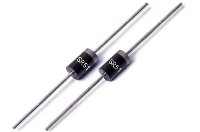

Hey there! I'm a supplier of FR207 fast recovery diodes. You might be wondering, "What is the forward current of FR207 at different temperatures?" Well, let's dig into this topic and find out!
First off, let's understand what the forward current of a diode is. In simple terms, the forward current is the current that flows through the diode when it's forward - biased. For the FR207, it's a crucial parameter as it determines how much power the diode can handle in a circuit.
Now, temperature plays a significant role in the performance of the FR207. At lower temperatures, the semiconductor material inside the diode has fewer thermally - generated carriers. This means that the resistance of the diode is relatively high, and the forward current is more restricted. As the temperature starts to rise, the number of thermally - generated carriers increases. These carriers contribute to the conduction process, making it easier for the current to flow through the diode.
Let's take a look at some typical values. At room temperature, say around 25°C, the forward current of the FR207 can handle up to a certain value. Usually, the datasheet of the FR207 will specify a maximum forward current rating. For most standard FR207 diodes, the continuous forward current rating at 25°C is around 2A. But this is just a nominal value.
As the temperature goes up, things start to change. The diode's internal resistance decreases due to the increased number of carriers. However, there's a catch. The power dissipation in the diode also increases with the forward current and temperature. If the temperature gets too high, the diode can overheat and eventually fail.
Let's consider a scenario where the temperature rises to 50°C. The forward current capability of the FR207 will be affected. The increased temperature causes the semiconductor material to become more conductive, but the power dissipation also becomes a concern. At this temperature, the maximum continuous forward current might be slightly reduced compared to the 25°C value. It could be around 1.8A or so, depending on the specific characteristics of the diode.
When the temperature reaches 75°C, the situation gets more critical. The higher temperature further reduces the resistance of the diode, but the power dissipation becomes a major factor. The maximum forward current might drop to around 1.5A. This is because the diode needs to dissipate more heat to maintain its integrity, and if the current is too high, it can cause thermal runaway.


At 100°C, the forward current capability of the FR207 is significantly reduced. The maximum continuous forward current might be around 1A. At this high temperature, the diode is operating close to its limits, and any further increase in current can lead to rapid overheating and failure.
It's important to note that these values are approximate and can vary depending on the manufacturer and the specific design of the FR207. That's why it's always a good idea to refer to the datasheet of the particular FR207 you're using.
Now, let's compare the FR207 with some of its cousins, the FR157 and the FR307. The FR157 has a lower continuous forward current rating compared to the FR207. At 25°C, the FR157 typically has a continuous forward current rating of around 1.5A. This means that it can handle less current than the FR207 at the same temperature.
On the other hand, the FR307 has a higher continuous forward current rating. At 25°C, the FR307 can handle up to 3A of continuous forward current. This makes it suitable for applications where higher power handling is required.
As a supplier of FR207 diodes, I know how important it is to choose the right diode for your application. If you're working on a project that operates at low temperatures and doesn't require a high current, the FR157 might be a good choice. But if you need a diode that can handle more current, especially at higher temperatures, the FR207 or the FR307 could be better options.
When designing a circuit with FR207 diodes, it's crucial to consider the temperature environment. You need to make sure that the forward current you're applying to the diode is within its capabilities at the expected operating temperature. If you're not sure, it's always a good idea to do some testing or consult with an engineer.
Another thing to keep in mind is the heat dissipation of the diode. You can use heat sinks or other cooling methods to help keep the temperature of the diode down. This can increase the forward current capability of the diode and improve its reliability.
So, if you're in the market for FR207 diodes or need more information about their forward current at different temperatures, I'm here to help. I can provide you with high - quality FR207 diodes that meet your specific requirements. Whether you're working on a small DIY project or a large - scale industrial application, I've got you covered.
If you're interested in purchasing FR207 diodes or want to discuss your specific needs further, feel free to reach out. We can have a chat about your project, the temperature requirements, and the best way to use the FR207 diodes in your circuit. You can visit our product page FR207 to learn more about the features and specifications of our FR207 diodes.
Let's work together to ensure that your project runs smoothly and efficiently with the right FR207 diodes. Don't hesitate to contact me for any questions or to start the procurement process.
References:
- Diode datasheets from major semiconductor manufacturers
- Textbooks on semiconductor devices and electronics