

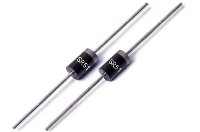

In the realm of electronic components, the SR3100 stands out as a remarkable device, offering high - performance rectification solutions for a wide range of applications. As a trusted SR3100 supplier, I am excited to delve into the intricacies of how this component operates, shedding light on its functionality, design, and the principles that govern its performance.


1. Basic Introduction to the SR3100
The SR3100 is a Schottky barrier diode, a type of semiconductor device known for its low forward voltage drop and fast switching characteristics. In contrast to conventional PN - junction diodes, Schottky diodes are formed by the junction of a metal and a semiconductor, typically n - type silicon. This unique construction gives the SR3100 several distinct advantages in electronic circuits.
The "SR" in SR3100 usually indicates a Schottky rectifier, the "3" represents its current - handling capacity, which is 3 amperes, and the "100" denotes its maximum reverse voltage rating of 100 volts. These specifications make the SR3100 suitable for applications where efficient power conversion and high - speed switching are required.
2. How the Schottky Barrier Works
To understand how the SR3100 works, we first need to grasp the concept of the Schottky barrier. When a metal is brought into contact with an n - type semiconductor, a potential barrier is formed at the interface. This barrier is known as the Schottky barrier.
In an n - type semiconductor, there are a large number of free electrons. When the metal is in contact with the semiconductor, electrons from the semiconductor flow into the metal until an equilibrium is reached. This flow of electrons creates a region near the metal - semiconductor interface that is depleted of free electrons, called the depletion region.
The height of the Schottky barrier depends on the work function of the metal and the electron affinity of the semiconductor. A lower barrier height allows for easier electron flow from the semiconductor to the metal when the diode is forward - biased.
3. Forward - Bias Operation of the SR3100
When a forward voltage is applied across the SR3100 (i.e., the anode is at a higher potential than the cathode), the external voltage opposes the Schottky barrier. As the forward voltage increases, the width of the depletion region decreases.
Once the forward voltage exceeds a certain threshold, known as the forward voltage drop (Vf), electrons can easily cross the Schottky barrier from the semiconductor to the metal. In the case of the SR3100, the forward voltage drop is relatively low compared to conventional PN - junction diodes. This low Vf results in less power dissipation in the diode when it is conducting current, making the SR3100 more energy - efficient.
For example, in a power supply circuit, a low Vf means that less energy is wasted as heat, leading to a higher overall efficiency of the power supply. When current flows through the SR3100 in the forward - bias condition, it can handle up to 3 amperes of current, as specified by its rating.
4. Reverse - Bias Operation of the SR3100
When a reverse voltage is applied across the SR3100 (the cathode is at a higher potential than the anode), the external voltage adds to the Schottky barrier. This causes the depletion region to widen.
In an ideal situation, no current would flow in the reverse - bias condition. However, in real - world Schottky diodes like the SR3100, there is a small amount of reverse leakage current (Ir). This current is due to the thermally - generated minority carriers in the semiconductor and the tunneling of electrons through the Schottky barrier.
The SR3100 is rated to withstand a maximum reverse voltage of 100 volts. If the reverse voltage exceeds this rating, the Schottky barrier may break down, leading to a large increase in reverse current, which can damage the diode.
5. Comparison with Other Diodes
It is interesting to compare the SR3100 with other similar diodes in the market. For instance, the SS14 is another Schottky diode. The SS14 has a lower current - handling capacity (1 ampere) compared to the SR3100's 3 amperes. This makes the SR3100 more suitable for applications that require higher current flow, such as in larger power supplies or high - power LED drivers.
On the other hand, the SR860 can handle a much higher current (8 amperes) but has a different reverse voltage rating. The SR860 is rated for a reverse voltage of 60 volts, while the SR3100 can withstand 100 volts. So, the choice between these diodes depends on the specific requirements of the application, including the current and voltage levels.
Another comparison can be made with the SR5100. The SR5100 has a current - handling capacity of 5 amperes, which is higher than the SR3100. If an application requires a higher current with the same reverse voltage rating, the SR5100 might be a better choice.
6. Applications of the SR3100
The SR3100's unique characteristics make it suitable for a variety of applications. In power supplies, it can be used as a rectifier to convert alternating current (AC) to direct current (DC). Its low forward voltage drop helps to improve the efficiency of the power supply, reducing energy consumption and heat generation.
In switch - mode power supplies (SMPS), the fast switching speed of the SR3100 is crucial. SMPS operate by rapidly switching a transistor on and off to control the output voltage. The SR3100 can quickly respond to these switching operations, ensuring smooth power conversion.
It is also used in voltage clamping circuits. In these circuits, the SR3100 can limit the voltage across a component to a safe level, protecting it from over - voltage damage.
7. Factors Affecting the Performance of the SR3100
Several factors can affect the performance of the SR3100. Temperature is one of the most significant factors. As the temperature increases, the reverse leakage current of the SR3100 also increases. This is because the thermally - generated minority carriers in the semiconductor become more active at higher temperatures.
The frequency of the applied voltage can also impact the performance. At high frequencies, the parasitic capacitance of the SR3100 can cause a decrease in its efficiency. The parasitic capacitance is an inherent property of the diode structure and can cause current to flow even when the diode is supposed to be non - conducting.
8. Quality and Reliability of the SR3100
As a supplier, we ensure the quality and reliability of the SR3100. We source the components from reputable manufacturers who follow strict quality control processes. During the manufacturing process, the metal - semiconductor junction is carefully formed to ensure a consistent Schottky barrier height.
We also perform various tests on the SR3100 before shipping. These tests include measuring the forward voltage drop, reverse leakage current, and reverse breakdown voltage. Only the components that meet our strict quality standards are delivered to our customers.
9. Contact for Procurement
If you are interested in purchasing the SR3100 for your electronic projects, we would be more than happy to discuss your requirements. Our team of experts can provide you with detailed technical support and guidance on the best usage of the SR3100 in your applications. Whether you need a small quantity for prototyping or a large - scale order for production, we can meet your needs. Please feel free to reach out to us to start the procurement and negotiation process.
References
- "Semiconductor Physics and Devices" by Donald A. Neamen
- "Microelectronic Circuits" by Adel S. Sedra and Kenneth C. Smith