

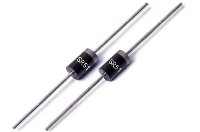

Hey there! As a supplier of FR107, I often get asked if this little component can be used in sensor circuits. Well, let's dive right into it and see what the deal is.
First off, what's FR107? It's a fast - recovery diode, and you can find more about it on this FR107 page. Fast - recovery diodes are known for their ability to switch from the conducting state to the non - conducting state very quickly. This is a crucial characteristic when it comes to a lot of electronic circuits, including sensor circuits.
Sensor circuits are all about detecting changes in the environment, whether it's light, temperature, pressure, or something else. They convert these physical changes into electrical signals that can be processed by other parts of the system. And here's where FR107 might come into play.
One of the key things in sensor circuits is signal rectification. Many sensors generate alternating current (AC) signals. These AC signals need to be converted into direct current (DC) so that they can be used by other components in the circuit, like microcontrollers. FR107 can be a great option for this rectification process. Its fast - recovery feature ensures that the conversion is efficient and that there's minimal loss of the signal.
Let's take a light sensor as an example. A photodiode in a light sensor might produce an AC signal based on the intensity of the light it detects. By using FR107 in the circuit, we can convert this AC signal into a DC signal. This DC signal can then be fed into an analog - to - digital converter (ADC) for further processing. The fast - recovery property of FR107 means that it can handle the rapid changes in the light - induced current, ensuring that the signal is accurately rectified.
Another aspect to consider is protection. Sensor circuits are often sensitive to voltage spikes and reverse currents. FR107 can act as a protective device. When there's a reverse current, the diode blocks it, preventing damage to the sensitive sensor components. For instance, in a temperature sensor circuit, sudden voltage surges could occur due to power supply fluctuations. FR107 can safeguard the circuit by blocking these unwanted reverse currents.
Now, you might be wondering about alternatives. There are other fast - recovery diodes out there, like FR307 and 1N4937. While these are also great options, FR107 has its own advantages. It has a relatively low forward voltage drop, which means less power is wasted as heat during the rectification process. This is especially important in sensor circuits, where power efficiency is often a concern.
However, it's not all sunshine and rainbows. There are some limitations to using FR107 in sensor circuits. For one, it has a maximum reverse voltage rating. If the reverse voltage in the circuit exceeds this rating, the diode could break down. So, you need to make sure that the circuit is designed in such a way that the reverse voltage stays within the safe limits of FR107.
Also, the current - handling capacity of FR107 is another factor. If the sensor circuit requires a high - current flow, FR107 might not be the best choice. In such cases, you might need to look at other diodes with higher current ratings.


When it comes to choosing the right component for a sensor circuit, it's all about balancing the requirements. You need to consider the type of sensor, the expected signal levels, and the overall power consumption of the circuit. If your sensor circuit has relatively low - power requirements and needs efficient rectification and protection, FR107 could be a great fit.
In conclusion, FR107 can definitely be used in sensor circuits, but it's important to understand its capabilities and limitations. If you're working on a sensor project and think FR107 might be the right choice for you, don't hesitate to reach out. We're here to help you find the best solutions for your circuit design. Whether you need more information about FR107 or want to discuss your specific requirements, we're just a message away. Let's talk and see how we can make your sensor circuit work at its best!
References:
- General knowledge about fast - recovery diodes and sensor circuits from electronics textbooks and industry experience.